Ayodhya’s saffron flag: size, meaning and key features
Saffron flag details explained ahead of Ayodhya’s Dhwajarohan ritual, from size to symbolism
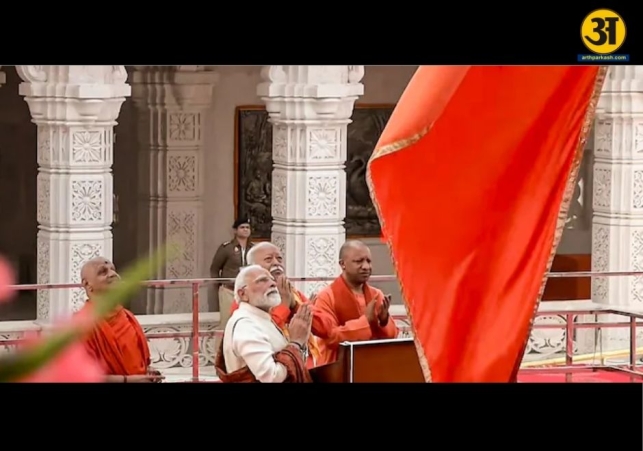
Ayodhya appeared bright and festive two days ago as the city celebrated Vivah Panchami, the day that marks the divine wedding of Lord Ram and Mata Sita. Along with the religious celebrations, the city also witnessed the historic Dhwajarohan ceremony at the Shri Ram Janmabhoomi Mandir. Prime Minister Narendra Modi had arrived in Ayodhya earlier in the morning to oversee and participate in the event. He later hoisted the saffron flag remotely atop the temple, marking an important spiritual moment for devotees across India.
The Dhwajarohan ceremony held special significance because it symbolised the victory of Dharma over Adharma, a theme deeply rooted in Hindu tradition. Residents, devotees, and visitors had filled the streets, and the temple complex had been decorated with flowers and lights. Many people had gathered to witness the Prime Minister’s visit and the special rituals organised at the temple. For Ayodhya, it was a day of pride, devotion, and celebration.
Significance and design of the saffron flag
The saffron flag hoisted on the temple two days ago had been specially prepared as per traditional descriptions from the Valmiki Ramayana. According to details shared by the Prime Minister’s Office, the flag was a right-angled triangular banner measuring 10 feet in height and 20 feet in length. It carried symbols with deep spiritual meaning. At the centre was a radiant Sun, representing Lord Ram’s brilliance, courage, and divine energy. Alongside it appeared the sacred Kovidara tree and the ‘Om’ symbol, signifying purity, strength, and the eternal presence of the divine.
The flag had been crafted carefully using parachute fabric stitched with silk threads, giving it a dignified and traditional appearance. It was designed to represent unity, cultural continuity, and the ideals associated with Ram Rajya. The triangular shape was chosen because it reflected ancient designs described in scripture. The flag was mounted on a tall 42-foot pole positioned at the top of the temple’s 161-foot Shikhar. When it was hoisted, it stood as a symbol of divinity, heritage, and the everlasting spirit of Lord Ram.
People in Ayodhya had expressed joy and pride at the careful planning and craftsmanship that went into preparing the ceremonial flag. Many devotees believed that the hoisting of the flag added another important chapter to the historic journey of the Shri Ram Janmabhoomi Mandir.
ALSO READ: Bangladesh faces rising tensions as legal battle over Hasina intensifies
ALSO READ: Dharmendra’s political journey reveals his surprising wish for absolute control
PM Modi’s schedule and temple visit
Prime Minister Narendra Modi had followed a detailed schedule during his visit. He landed at Maharishi Valmiki International Airport in Ayodhya at around 10 AM. From the airport, he travelled by helicopter to Saket Mahavidyalaya. After this, he proceeded by road towards the Shankaracharya entrance of the Ram Mandir.
The 2.5-kilometre stretch between Saket Mahavidyalaya and the temple had been beautifully decorated for the occasion. Nearly 1,000 students from Saket Mahavidyalaya and Avadh University stood along the route to shower flowers on the Prime Minister as his vehicle passed. Crowds had gathered on both sides of the road to catch a glimpse of him and to be part of the historic celebration.
Upon reaching the temple complex, the Prime Minister first offered prayers at the Sapt Mandir. He then visited the Sheshavatar Mandir and the Mata Annapurna Mandir, where rituals were performed. Around 11 AM, he reached the Ram Darbar Garbhagrih, where he conducted darshan and pooja. After completing the rituals, he remotely hoisted the saffron flag atop the temple Shikhar. The moment was streamed live, allowing devotees across the country to witness the ceremony.
The event reflected a blend of traditional rituals and modern technology, allowing thousands of people to participate virtually even if they could not be physically present at the temple.
Enhanced security arrangements across the city
Because of the Prime Minister’s visit and the large crowds expected, security arrangements in Ayodhya had been strengthened on a massive scale. Seven stages were set up along the route for cultural performances, showcasing traditional songs, dances, and festivities. The entire stretch had been decorated with marigold flowers, adding to the festive spirit of the city.
Security forces created a five-layer protective ring around the Prime Minister. Police personnel, magistrates, Anti-Terrorism Squad officers, Special Task Force units, SWAT commandos, and paramilitary soldiers were deployed throughout the area. These teams were positioned across a 15-kilometre radius surrounding the temple route. In total, around 7,000 security personnel were assigned to ensure that the event was conducted safely and smoothly.
Officials had monitored movement and crowd flow closely to prevent any disruption. Traffic routes were carefully managed, and emergency services were kept ready. Despite the large turnout, the event concluded peacefully, with both locals and visitors expressing satisfaction with the arrangements.
Ayodhya’s Dhwajarohan ceremony became a memorable moment not only for the city but also for people across India. The combination of cultural devotion, traditional symbolism, and high-level organisation made the occasion significant and widely discussed. Two days after the event, the city continued to enjoy the festive atmosphere and the pride of hosting a historic religious celebration.
Related News